
Early Career Occupational Hygienist Essay 2026 – Luca Hervada
Artificial intelligence (AI) systems are capable of reasoning, decision making and perception, tasks historically requiring human intelligence. AI encompasses a wide range of technologies – those of particular significance and potential to affect industry, being machine and deep learning. From lung imaging within the medical field to AI-enabled personal protective equipment (PPE) in the construction industry, data has shown a reduction in worker illness and injury after adopting AI technology (1). AI has the potential to streamline large datasets, locating trends, enhancing decision-making and hazard perception – possibly providing solutions for improved worker health protection. On the other hand, AI technologies may introduce data biases and lead to a reduction in worker autonomy through automation.
AI is affecting and will continue to affect industry. Termed the ‘Industrial Revolution 4.0’, businesses and industries are focussing more on automation and machinery for efficient manufacturing and workforce optimisation (2). A report by the National Foundation for Educational Research stated that up to 3 million low-skilled jobs could disappear in the UK by 2035 due to automation and replacement with AI (3). In contrast, other research stated AI would affect highly skilled occupations, with technical and creative roles experiencing the steepest declines (4). In some industries, the replacement of human staff allows for more optimizable and efficient stages, ultimately reducing menial manual tasks.
Industrial robotics, powered by AI and machine learning (ML), have reduced assembly times by 30%, whilst increasing product quality by 15%. Industrial robotics enhance autonomy, reducing errors and energy use by 30% and 20% respectively (5). For example, industrial welding robotics are designed to perform welding activities with high accuracy and speed (Figure 1). These systems are adaptable and reprogrammable to different tasks. Automatic weld quality monitoring systems are able to classify weld defects such as porosity, metal spatter, irregular bead shape, incomplete penetrations and burn-through, reducing manpower required for inspection (6). The automation of welding activities reduces personal exposure to weld fume – with, on average, a typical manual metal inert gas welder producing 30kg of weld fume per year. Welding robotics can be combined with precision local exhaust ventilation (LEV) systems to further reduce weld fume exposure to peripheral workers. For example, AES Ltd, based in Glasgow, produce specialist, robotic LEV to match the geometry and movement of robotic arms, subsequently reducing welding fume exposure for operators and peripheral workers (Figure 2). Similarly, the use of AI in industry allows for remote working and supervision. Smart task allocation using AI allows progressive efficiency. Overall, AI is advancing industry, however, this presents challenges with complex maintenance and emerging hazards present in the workplace.
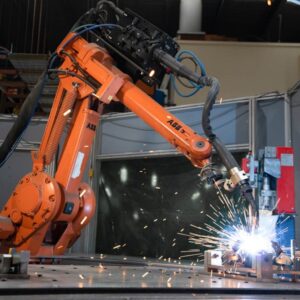
Figure 1. Industrial welding robotics. Control units and advanced sensors coordinate robot motion and parameters. Weld quality is maintained through a seam tracking vision system, often using AI for enhanced efficiency and precision (6)(16).
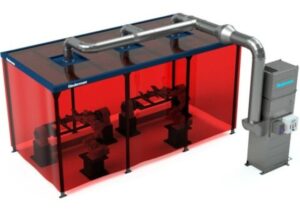
Figure 2. AES Ltd. of Glasgow provide robotic LEV solutions to comply with COSHH regulations, minimise fume exposure and seamlessly integrate into welding stations. These solutions maintain productivity, whilst protecting the workforce (16).
As discussed, increased use of AI in industry has the potential to reduce workplace hazards and individual exposures to hazardous substances, through replacement of workers with robotic technology. However, a future highly automated technological industry, presents new workplace hazards to risk assess, and review. AI technology is able to identify risks and hazards in the workplace, which are often missed by humans (7). Automation of manual tasks reduces exposures of individuals to certain hazards, such as noise and manual handling. The use of efficient industrial welding robotics reduces personal exposure to weld fume but creates a new set of hazards. Unexpected robotic movement, often caused by malfunctioning safety systems, human error in programming and sensor malfunctions, present crushing and impact hazards. High voltages to power robotic technology present electrical hazards for maintenance staff (8).
AI in industry can be used to provide real-time monitoring of workplaces, allowing for the creation of detailed safety solutions. Computer vision technology uses a combination of CCTV alongside AI algorithms to detect hazards. For example, in a manufacturing environment, PPE usage (including gloves and helmets) was able to be detected for workers. Furthermore, computer vision allows the tracking of vehicular and plant movements, allowing early detection of hazardous behaviours (9). Similarly, AI is enhancing the safety of industrial welding robotics. Advanced monitoring systems are able to analyse robotic movements in real-time, predicting potential failures and continuously learning to improve safety protocols (8). As such, the use of AI technology in industry is shifting and reducing traditional hazard profiles whilst increasing technological, specific hazards, altering the types and durations of personal exposures to harmful substances.
The increased use of AI in industry will directly affect Occupational Hygiene practice. Individuals working in an AI dominated industry will display more dynamic exposure profiles. As AI driven processes change regularly, standard sampling techniques may no longer be suitable for monitoring personal exposure. The variability in exposure patterns requires continuous monitoring. Wearable technology with fixed sensors provides real-time exposure data for analysis. Smart PPE and wearable technologies allow collection of data regarding the workforce and their surroundings, potentially aiding in the reduction of work-related accidents and illness (7).
AI tools and ML are available to analyse vast datasets of personal exposures to identify correlations and predictive relationships that may not be apparent through traditional statistical methods (10). ML is directly able to forecast when personal exposures are likely to exceed workplace exposure limits and can aid in supporting prioritisation of high-risk tasks or employees. The EPHOR project developed methods and tools to better characterise the working-life exposome. AI has the potential to analyse, identify trends and provide insight on working life exposure-response data, thus having beneficial health and economic impacts (11). AI and ML technology has been shown to be effective in monitoring air pollution and forecasting in cities and regional places. The advancement of cost-effective sensors and clinical data means a surge in pollution datasets. AI and ML tools provide real-time tracking of pollution hot spots and are able to identify trends (12). Advancing technology allows researchers and policymakers to make informed decisions concerning air quality management and the protection of health. With time, this technology could be implemented into workplaces by occupational hygienists where air quality requires assessment to identify trends and provide insight into the control of hazardous substances.
AI can also be used for predictive exposure modelling; over-exposures can be predicted depending on task, production rate, worker behaviour, weather and ventilation rate. As such, data interpretation is enhanced by AI and ML. Occupational hygienists must understand how to use AI outputs and acknowledge the limitations of the technology. A firm understanding of data analytics becomes essential, as occupational hygienists allocate less time to data collection, and more time to analyses. It becomes the responsibility of the occupational hygienist to ensure that personal data is stored, processed and acknowledged responsibly. Individual privacy is paramount in a future, AI-focussed workplace.
The effects AI will have on the profession of Occupational Hygiene will be gradual. Over time, the methods to protect worker health will change. Occupational hygienists will be less required to inspect, assess and implement controls for the protection of worker health – AI can aid in this, too. Future workplaces are likely to undergo significant changes – increases in size, their complexity and workforce. Traditional risk assessment methods often leave critical vulnerabilities unaddressed, leading to productivity losses and accidents. AI algorithms can analyse historical safety data, environmental variables and worker behaviour to predict future possible accident scenarios (13). Using AI, risk assessments become more dynamic. Early warning systems are able to flag when unsafe conditions or exposures are likely, therefore re-shaping the profession and altering how exposure to hazardous substances is controlled. Furthermore, the future use of AI technologies may change how occupational hygienists allocate their time. Occupational hygienists may spend less time on routine sampling, shifting their focus to risk management, workforce communication and process design.
The profession of Occupational Hygiene in an AI-enhanced industry requires a sound understanding of AI technology, and its limitations. Occupational hygienists will be required to understand, engineer and communicate insights from AI technologies to senior staff and the workforce. AI possesses the power to produce draft reports from sampling data. As a profession, there will be greater collaboration with IT specialists and data engineers, bridging the gap between Occupational Hygiene and data sciences. Occupational hygienists will have greater responsibilities to ensure that their AI models are valid, and suitable for the process or assessment. With increased use of AI, the judgment of occupational hygienists becomes more important – AI cannot build trusting relationships with the workforce, understand workplace culture or interpret workforce context behind data. These core strengths and skills in the profession of Occupational Hygiene are irreplaceable.
Increased use of AI in industry presents challenges for the profession of Occupational Hygiene. Traditionally, the use of AI allows more informed decisions, as AI can effectively process large amounts of information with the exclusion of human flaws, such as cognitive bias (14). However, occasionally AI recommendations and outcomes can be misleading. Algorithmic biases can lead to unfavourable treatments, unprofitable outcomes, and arising safety hazards in robotics (14). As such, over-reliance of AI in Occupational Hygiene carries risks, potentially leading to mismanagement of the control of hazardous substances or personal exposures in the workplace. These are long term implications that need to be understood by occupational hygienists to ensure the longevity of the workforce in a dynamic field. When using AI for risk assessment, it is possible for AI to misclassify hazards. Occasionally AI technology may provide misleading information to those who do not have the knowledge to detect this happening. AI technologies are capable of ‘hallucinations’, producing text that is factually incorrect (15), possibly allowing occupational hygienists to be misled in their risk assessment process. An increased use of CCTV paired with AI algorithms for hazard detection may create tension, eroding trust between the occupational hygienist and workforce. Increased AI use will have positive and negative effects on the profession of Occupational Hygiene.
AI has the potential to reshape industry and alter traditional workplace hazards. For example, the use of industrial robotics reduces personal exposure to weld fume. CCTV combined with AI algorithms can detect hazards ahead of time, and flag if individuals in the workplace are using the correct PPE. Advances in AI technology allows comprehensive risk assessment, outlining risks that may have been missed using traditional methods. Occupational Hygiene practice becomes more refined as AI technologies exist for predictive exposure modelling and data analysis. The use of AI in industry presents challenges that must be acknowledged and understood. As such, occupational hygienists will become strategists, in a data focussed, more predictable field.
Reference List
- Jetha A, Bakhtari H, Irvin E, Biswas A, Smith MJ, Mustard C, Arrandale VH, Dennerlein JT, Smith PM. Do occupational health and safety tools that utilize artificial intelligence have a measurable impact on worker injury or illness? Findings from a systematic review. Systematic reviews. 2025 Jul 11;14(1):146.
- Rashid AB, Kausik MA. AI revolutionizing industries worldwide: A comprehensive overview of its diverse applications. Hybrid Advances. 2024 Dec 1;7:100277.
- Bocock, L., Scott, M., and Hillary, J. (2025). The Skills Imperative 2035: Creating a system of lifelong learning to provide the essential skills for tomorrow’s workforce. Final report from The Skills Imperative 2035: Essential skills for tomorrow’s workforce. Slough: NFER.
- Klein Teeselink, Bouke, Generative AI and Labor Market Outcomes: Evidence from the United Kingdom (September 22, 2025). Available at SSRN: https://ssrn.com/abstract=5516798or http://dx.doi.org/10.2139/ssrn.5516798
- Urrea C, Kern J. Recent Advances and Challenges in Industrial Robotics: A Systematic Review of Technological Trends and Emerging Applications. Processes. 2025 Mar 12;13(3):832.
- Kah P, Shrestha M, Hiltunen E, Martikainen J. Robotic arc welding sensors and programming in industrial applications. International Journal of Mechanical and Materials Engineering. 2015 Dec;10(1):13.
- Shah IA, Mishra S. Artificial intelligence in advancing occupational health and safety: an encapsulation of developments. Journal of Occupational Health. 2024 Jan;66(1):uiad017.
- The Hidden Dangers of Industry Welding Robots: What Every Worker Needs to Know [Internet]. ATX Industries. 2025. Available from: https://atx-industries.com/the-hidden-dangers-of-industry-welding-robots-what-every-worker-needs-to-know/
- Hoang ND. Image Processing-Based recognition of wall defects using machine learning approaches and steerable filters. Computational Intelligence and Neuroscience [Internet]. 2018 Nov 15;2018:1–18. Available from: https://doi.org/10.1155/2018/7913952
- Singh AV, Bhardwaj P, Laux P, Pradeep P, Busse M, Luch A, Hirose A, Osgood CJ, Stacey MW. AI and ML-based risk assessment of chemicals: predicting carcinogenic risk from chemical-induced genomic instability. Frontiers in toxicology. 2024 Nov 26;6:1461587.
- About [Internet]. EPHOR Project. Available from: https://www.ephor-project.eu/about-ephor
- Chadalavada S, Faust O, Salvi M, Seoni S, Raj N, Raghavendra U, Gudigar A, Barua PD, Molinari F, Acharya R. Application of artificial intelligence in air pollution monitoring and forecasting: A systematic review. Environmental Modelling & Software. 2024 Dec 29:106312.
- Patrick Ohis Ailemen “Integrating Artificial Intelligence to Enhance Risk Assessment in Occupational Health and Safety for Facility Management” Iconic Research And Engineering Journals Volume 8 Issue 6 2024 Page 597-607
- Klingbeil A, Grützner C, Schreck P. Trust and reliance on AI—An experimental study on the extent and costs of overreliance on AI. Computers in Human Behavior. 2024 Nov 1;160:108352.
- Stødle K, Flage R, Guikema S, Aven T. Artificial intelligence for risk analysis—A risk characterization perspective on advances, opportunities, and limitations. Risk Analysis. 2025 Apr;45(4):738-51.
- Robotic Welding LEV Solutions by AES Ltd. – AES Ltd | LEV Testing | Dust & Fume Extraction [Internet]. AES Ltd | LEV Testing | Dust & Fume Extraction. 2025. Available from: https://aessolutions.co.uk/industry/dust-fume-extraction/weld-fume/robotic-welding-lev/